Infra red (IR) transmission has been used in some applications as a communication medium, suited to systems with a direct line-of-sight between devices. IR for example is often used for wireless communication between a PC and a laptop.
IR can be used with active ID tags, but not with low cost passive tags. Thus there has been instead a huge acceptance of radio frequency (RF) technology for wireless communication. An example is the cordless keyboard and mouse, but this also shows the limitations of positioning and battery life; this is a common example worth thinking about when considering RFID systems.
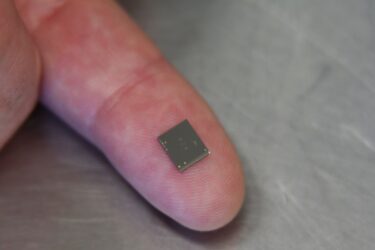
It is easy to provide power to a reader, but only the expensive active sort has power at the tag. But the basic requirement is to read data from the tag, i.e. the tag transmits, so that the tag itself needs power for the duration of a transmission. The trick for passive tags is to build a tiny aerial (Antenna) into the chip which uses the electro magnetic field transmitted from the reader (rather like an air coupled transformer) and transfers enough power from the reader to power up the chip’s transmitter long enough to make the data transmission. This explains why there are serious restrictions on the distance that can be reliably used between reader and tag. It should be noted that an active tag would only be switched on by the reader, but then it can use its own battery to transmit a higher power signal. Passive tags/readers work with centimetres separation, active ones with metres!
The common passive tags are mass produced with a unique ID code embedded inside; clearly as technology develops some updating of this basic data will be enabled, updating the “time of last reading” for instance. For the conventional retail application this is probably enough, since the readers will be used as data sources for integrated database supported applications. However where the tagged item is mobile such as a security system, global transport, military field support, etc., the ability to store and update a reasonable sized data record would have huge advantages.
The next problem is one of collecting data from a specific tag when it is close to one or more others. This is not a new problem; it is the common one in local area networks. The solutions to ensuring each and every device attached to the LAN had equal rights and no two devices would transmit conflicting data was solved by one of two protocols, collision avoidance (Token ring) or collision detection (Ethernet). The Ethernet protocol however originated in a wide area network developed in Hawaii (aloha-net), so it has a good pedigree for use in RFID as well as wireless LANs. Security is a big issue in wireless LANs and it may well become one in RFID, although at the level of items on the store shelves that is a bit far fetched. But it certainly is in military applications and probably for goods in transit; there are certainly worries about other people picking up details from the longer range RF transmissions possible with active tags (there is always a downside, isn’t there?).
Some computing power is needed to implement a protocol which would allow a reader to be pointed at a group of tagged items and to access all the tags in the group either all individually, a selected set or all the same. This would be ideal for store shelf systems, but it would require active tags today; tomorrow low cost passive tags will probably be developed, but physical positioning will remain a limitation until then.< BR>
Martin Healey, pioneer development Intel-based computers en c/s-architecture. Director of a number of IT specialist companies and an Emeritus Professor of the University of Wales.