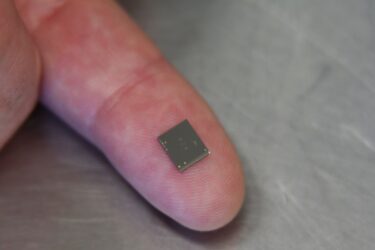
With the exception of the mobile phone SIM card, most smart cards today are of the simpler memory card variety. They are a step forward from the common magnetic stripe cards but they do not have the vast potential of a full smart card, one that has a complete computer-on-a-chip embedded in the card, not simply more storage.
Quite obviously a computer-based smart card is a lot more expensive than a memory card and this is one of the prime factors why there is relatively little penetration in the market place. There are thousands of memory cards sold for public phone systems but this was only successful because of the low cost of disposable cards.
There are however some examples of financial POS terminals which are making more use of the memory card by updating the data on the card, perpetuating the use of the card rather than discarding a used one. Indeed the convergence of smart card and credit/debit card is inevitable when it becomes cost effective.
However, given the time scales, it is more likely that computer embedded smart cards will come down in price as the applications develop and that they will become the norm. The processor gives the card the ability to handle a number of applications, enabling the one card to replace numerous magnetic stripe cards. The programmability enables multi-functionality.
The computer embedded on the smart cards of today is dominated by an old design of 8-bit processor, the 8051, commonly used in embedded computer equipment such as printers, data capture terminals, programmable logic controllers, etc. However just as those devices have become more sophisticated and have demanded more processing power and higher memory capacity, the same will be true of smart cards. Already 16-bit processor based cards are available and there are experimental 32-bit ones around. These also support considerable amounts of memory, both RAM, ROM and non-volatile RAM.
There are obviously drawbacks to the 16 and 32-bit processor cards, or else there would be no need for the simpler cards. The obvious one is, as mentioned before, price. A simple memory card can cost less than $1.00, while a full scale 32-bit card will cost over $50.00. Admittedly a lot of this is due to the fact that memory cards are already used in high volume while computer cards are only in low volume production. It will change but not yet awhile.
The second drawback is that while it would be nice to combine the function of credit/debit card with an identity and medical card, not to mention loyalty cards, there are many commercial obstacles yet to overcome. In practice the up-market smart cards are only being used today for specialised applications which can justify the high cost associated with relatively low volume. For the volumes to increase there must be willingness for all commercial, retail and financial organisations to cooperate and to work with compatible technologies. This is asking a lot, because in many cases the companies that need to cooperate are in direct competition.
The most common denominator in the smart card market is financial transactions. Even retail competitors have come to terms with the need for a common credit card system, although it took a long time. The same is needed for smart cards. To this end it now appears that the big financial institutions have accepted the need for cooperation and Europay, MasterCard and Visa have agreed on a standard for interchange between a card and a terminal, the so called EMV standard. Unfortunately this is a European initiative and the Americans are not yet tuned in (the not-invented-here-syndrome I fear). But this also shows the problems of inertia, since although the standard has been published and refined, there are very few implementations of it yet. At least it is a step in the right direction.
From the general public’s point of view the smart card has the obvious advantage over magnetic stripe cards in that the one physical card could replace the multitude of cards many of us carry around. This of course is not the whole story, but it is an important one in the fight to gain acceptance generally.
For the time being security applications are the most likely to drive development forward because with the growing threat of sabotage the current technology can often be cost justified. Financial applications will probably drive the lower end forward, security the top end.
Martin Healey, pioneer development Intel-based computers en c/s-architecture. Director of a number of IT specialist companies and an Emeritus Professor of the University of Wales.