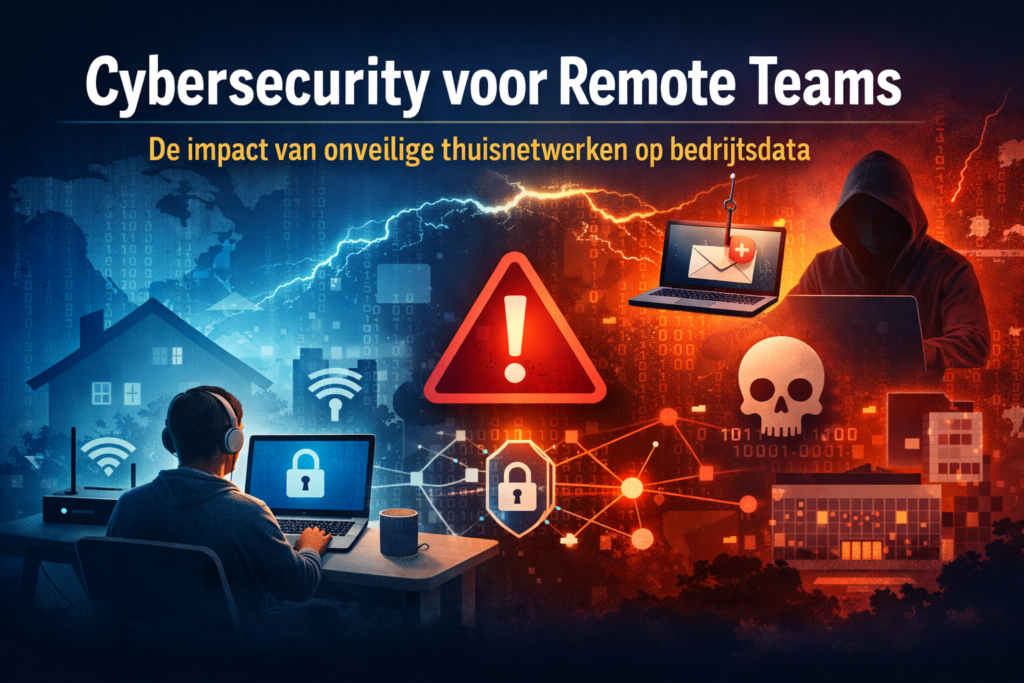
Remote werken is niet meer weg te denken uit het moderne bedrijfsleven, maar brengt ook nieuwe cybersecurity-uitdagingen met zich mee. Thuisnetwerken zijn vaak minder goed beveiligd dan bedrijfsnetwerken, waardoor ze een aantrekkelijk doelwit vormen voor cybercriminelen en een direct risico kunnen opleveren voor gevoelige bedrijfsdata.
For many organizations, remote working is no longer a temporary solution but a permanent part of their operations. Teams are working from home, coworking spaces, or temporary locations, often with access to sensitive company data. This shift has fundamentally changed how organizations view cybersecurity. While security used to be largely managed within the office, employees’ home networks are now a vital part of their digital defenses.
However, home networks are rarely designed with professional security in mind. This makes them an attractive target for cybercriminals looking for vulnerabilities to access corporate information.
Why Home Networks Are a Weak Link
In an office environment, networks are typically managed by IT professionals, with strict security measures and continuous monitoring. Home networks almost always lack this structure. Employees often use the default settings that come with the router, unaware of the risks.
Common vulnerabilities in home networks include:
- Outdated routers with unpatched security vulnerabilities
- Weak or reused Wi-Fi passwords
- Family members’ devices on the same network
- No separate networks for work and private use
These factors make it easier for attackers to penetrate a network and then move towards corporate data.
The top cybersecurity risks for remote teams
When employees work from home, a larger attack vector emerges. Cybercriminals are increasingly targeting individual employees rather than companies themselves. Some common threats include:
Data interception:
Insufficiently secured Wi-Fi networks allow data traffic to be intercepted. This can lead to login credentials, emails, and files being stolen without the user’s knowledge.
Malware and ransomware:
Personal devices used for work are at a higher risk of infection. An infected laptop can access internal company systems as soon as it’s connected.
Phishing and social engineering:
Remote workers often lack direct control over their colleagues. Cybercriminals exploit this by posing as managers or IT departments to gain access to accounts.
Unauthorized Access
Without additional security, an attacker can gain direct access to cloud environments or internal applications via a home network.
Consequences for business data and organizational continuity
The impact of an insecure home network extends beyond the individual employee. A single weak connection can lead to widespread damage to an organization.
Possible consequences include:
- Data breaches involving sensitive customer or company information
- Legal and compliance issues, especially with privacy legislation
- Financial damage due to downtime or extortion
- Reputational damage and loss of customer confidence
For companies with multiple remote employees, this risk multiplies quickly, especially when security is not centrally managed.
Realistic real-life scenarios
To make the risks more concrete, it’s important to consider situations that often occur in practice. Consider an employee working on a router that hasn’t received any updates in years. An attacker discovers a known security vulnerability and gains access to the network. Stored passwords are then intercepted, which are used to compromise company accounts.
Another scenario is sharing the home network with smart devices like cameras or televisions. These devices often have minimal security and are an ideal entry point for cybercriminals.
Basic measures for working safely from home
Although home networks are vulnerable, simple measures can significantly reduce the risk. Both employees and organizations play a role in this.
Important steps for employees are:
- Changing default router passwords
- Regularly update router firmware
- Using strong Wi-Fi encryption
- Lock devices and keep them up to date
By implementing these basic measures, it will be much more difficult for attackers to break in.
The role of additional security solutions
Besides basic measures, additional solutions are often deployed to improve the security of remote teams. One of these is the use of a secure connection when employees access company data via public or private networks.
Information about reliable solutions and background knowledge on secure connections can be found on platforms like VPNGids.nl , where various security options are clearly discussed and compared. This helps organizations and employees make more informed choices about their digital security.
Responsibility of organizations
While employees manage their home networks, the organization remains ultimately responsible for protecting company data. Companies cannot leave this entirely to individuals without clear guidelines and support.
Effective organizational measures include:
- Mandatory multi-factor authentication
- Policy for the use of private devices
- Central endpoint security
- Regular security awareness training
By setting clear expectations and providing resources, organizations reduce the chance of human error.
Shared responsibility between employer and employee
Cybersecurity in remote work is a shared responsibility. Employees must be aware of their digital environment, while employers must ensure clear frameworks and support. Without collaboration, security gaps arise that are difficult to close.
A transparent approach, where employees understand why certain measures are necessary, increases compliance and reduces the risk of incidents.
The future of cybersecurity for remote teams
Remote working will continue to evolve, and with it, the threats. Cybercriminals are constantly adapting their methods and increasingly targeting remote workers as a gateway to larger organizations.
In the future, companies will increasingly focus on zero trust models, where no connection is automatically trusted. Every device and user is continuously monitored, regardless of location.
Conclusion
Insecure home networks pose a serious risk to company data in an era where remote working has become the norm. What starts as a minor vulnerability in an individual employee can escalate into a large-scale security incident with serious consequences.
By raising awareness, implementing basic measures, and establishing clear responsibilities, organizations can significantly mitigate these risks. Cybersecurity for remote teams isn’t a one-time effort, but an ongoing process that evolves with the way we work.